Friday, 11 January 2013

Research Point : Lorrain & Turner Dividing Landscapes P.83

Research Point : Lorrain & Turner Dividing Landscapes P.83


A Sunset or Landscape with Argus Guarding Io - Claude Lorrain C17th

This Claude Lorrain piece is not framed by trees in the foreground as with the Turner piece but by quite a bit of interesting storytelling with the animal approaching the pond. All the action appears to be going in the foreground with the waterfall running down the right side of the picture. The mid-ground has the suggestion of a river and bridge but not too much to distract the viewer. It is as thought this part of the picture is just out of the viewers peripheral vision, creating the illusion of depth as you stare into the foreground.


Bolton Abbey - JMW Turner 1809
As we can see with this Turner piece of Bolton Abbey, the trees in the foreground are quite dominant, particularly to the right side of the picture giving the viewer the sense that they are sitting in a forest, and just peering out of the brush. A similar effect can be produced by an artist painting indoors, and including the window sill as part of the piece. The river serves to create distance by drawing the viewer, deeper into the painting as the trees become gradually smaller. The distant hills appear quite faded to suggest distance in the background.


http://www.telegraph.co.uk/news/uknews/2652217/Wind-farm-planned-for-famous-JMW-Turner-landscape-at-Bolton-Abbey.html

http://www.kunst-fuer-alle.de/english/fine-art/artist/image/claude-lorrain/6612/1/68624/a-sunset-or-landscape-with-argus-guarding-io/index.htm

Check and Log


  • In what way did you simplify and select in your study? Were you able to focus on simple shapes and patterns amid all the visual information available to you.?
I think that using the viewfinder aids the artist to focus on what to put in a painting, because unlike sight, the viewfinder limits what the person sees and forces you to think about what is valuable to the painting with the space available. When looking at potential sketches, I found myself using the camera on my mobile phone as a simple way to frame what I am seeing, then to decide if the information was interesting enough to sketch.
  • How did you create a sense of distance and form in your sketches?
I would follow the rules that a foreground is clearer, more detailed and richer in colour whereas the background would be vague, blurry and the colours would be much weaker. Trees can be suggested by squiggles for example and the foreground may overlap the mid ground and background being that it is closer to the viewer. Aspects within the picture, such as a winding river, or rolling hillside, give the perspective of distance as does the size of the objects, gradually getting smaller, the farther back they go.
  • How did you use light and shade? Was it successful? 
I think I used light and shade well in the "Cloud" exercises, for example, using the white paper to represent light against the shading of my medium. This also works quite with the church Sketch ( Plotting Space through composition) where the eraser created cloud edges. If I am honest, the sketches in " A Sketchbook Walk" are just line sketches so I would consider those unsuccessful in terms of light and shade. My 360 degree study is better but so much as my cloud study.
  • What additional preliminary work would have been helpful towards the larger study?
I think a good selection of sketches, detailing the direction of light and tone would be complimented with the use of photographs where possible, it would of certainly helped Monet with his series studies, had he had a camera. Also, having a familiarity with the study already would be useful, as stated, many artists draw at the same location which would surely help to memorize some of the surrounding detail.

Plotting Space Through Composition and Structure P. 81

Plotting Space Through Composition and Structure P. 81

For this exercise, I chose to use a photograph that I took at the end of summer at Warwick Castle. The church is a good central feature, as well as hills in the background and quite a busy foreground. I used a bit of smudged graphite for the sky, which I then erased in places to create clouds & light.


For the church, I used a HP pencil, and a 2B for the foreground. The background is a mixture of soft pastel light grey and 4H. 

Diagram showing how I have split the picture into 3 sections, Background, Mid-ground and Foreground.


Drawing Cloud Formations P.80

Drawing Cloud Formations P.80


I am finding this exercise really enjoyable and will continue to add cloud sketches to this blog. The great thing about doing this is the spontaneous nature of how clouds form and I am finding it really handy to have a sketch pad on hand because as quick as they form they disappear or lose shape just as fast.


In the top left picture, the sun is hidden quite deep behind the cloud, but it is illuminating the cloud edge. I have used a graphite Pencil to create the cloud, the added a soft pastel grey to create a sky effect (which was blue at the time). I have tried to create semi transparency in places, with dense thick cloud at the darkest points.  In the bottom Left & Right sketches, I was lucky enough to catch a distant rain cloud, but it was moving out of view so I quickly draw the right sketch first to basically highlight tones, and to tell me which direction the the rain was going. I then did a soft pastel sketch on the left, using a smudge technique to drag the rain/mist downwards.


More cloud attempts from my sketchbook, using a variety of mediums. I found the colouring pencils work quite well, concentrating on the colouring in the blue negative space to create the cloud. I found ink much harder in getting the cloud effect, not so much with shading but with the outline that the pen makes.


I did attempt to try oil pastel to create a sunset ( from a photo I took in Autumn) but I was having difficulty with overlaying the orange red clouds against the blue/purple background. I felt it looked too flat, like the red cloud was not in front of the sky like on the photo.It is a shame as I was starting to get the distant dark clouds on the horizon looking quite well. However, I know the oil pastel can be lifted off (hence the scratch marks) so it is a picture I may go back too at some point.


Research Point : Artists who work in series in Landscapes P.79

Research Point : Artists who work in series in Landscapes P.79


Monet : The Rouen Cathedral 1892


Monet started work on The Rouen Cathedral series in 1892 which took over a year to complete. Monet rented a room across from the cathedral which acted as his studio during this time. Approximately 30 paintings of the cathedral were painting throughout the year but only a select few were exhibitioned at a later date. Amongst some of the more practical difficulties that Monet faced would be the commitment of such a long term project and the resources to fund this exercise. According to the Art Wolf Online Art Magazine, Monet would work on various canvasses simultaneously and seemed more interested in how light affected the conditions around the cathedral throughout the year and not so much the cathedral itself. By experimenting with different luminances and climate conditions, the cathedral lost its architectural prowess and detail in Monet's paintings.

This lead me to look into how repetition of painting the same scene could become habit forming to a point of obsession. In the research paper  Monet's Series: Repetition, Obsession By Steven Z. Levine (1986) he talks about how Monet could be seen to always trying to better himself with each painting, an admission he made himself to Alice Hoschede in 1884 by saying " it always seemed to me that in the beginning again I will do better" and how Monet would get lured into repeating previous efforts. Furthermore in The Encyclopedia of Impressionism (1997), Michael Howard writes "the pictures gave him intense difficulties, which threw him into despair. He had vivid nightmares of the cathedral in various colors, pink, blue and yellow, falling upon him". It just seems to me that it would take a strong person to emotionally detach themselves from an art project on such a grand scale. living and breathing it with no rest period topped with a perfectist trait that is always trying to improve.


Paul Cézanne : Mont Sainte-Victoire  1885–1887


 Sharing some similarity. Picasso said of Cezanne,“He was my sole and only one teacher, He was the mother of all of us” where Picasso was not traditionally known for landscape work, the opposite can be said for Cézanne, who painted Mount Sainte-Victoire in Aix-en-Provence often. But unlike Monet, who painted quite similar pieces in series, in terms of the subject matter, Cezanne incorporated various types of vegetation within his series. His cubist approach also allowed him to see shapes in the natural forms of the landscape, using triangles, squares, diamonds and circles of different sizes to show perspective.

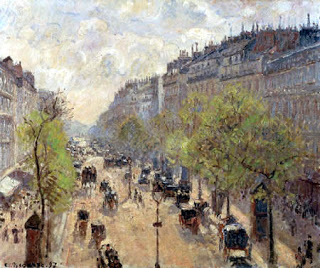
Below is the series work of Camille Pissarro, a Danish-French Impressionist who was interested in the human figure as a compliment to his landscape work, as he always seeked to find the " perfect method of expressing himself and his ideas" throughout his long career. From the off, thinking about how Pissarro would tackle a Series, unlike Monet, his subject was in constant movement, in that humans were just as important to him. This is quite evident in the many pictures of The Boulevard Montmartre where it could be argued that the scene would constantly be in transit, and if I were to put myself in Pissarro's place, I would feel that that too some extent, never fully understanding the composition in a way that Monet knew the the Rouen Cathedral, the reverse of this is that Pissarro had the option to just focus on the Boulevard and not the movement of traffic but chose not too. I have to say, there is a certain charm and humanity about Pissarro's Boulevard that would be sorely missed without the moving traffic and his series work would not have seemed quite so repetitive given the different types of people passing through.


Pissarro - The Boulevard Montmartre 1897


http://www.ibiblio.org/wm/paint/auth/monet/rouen/
http://www.theartwolf.com/landscapes/cezanne-montagne-sainte-victoire.htm
http://mary-adam.blogspot.co.uk/2010/01/picassos-landscaprs.html
http://www.jstor.org Monet's Series: Repetition, Obsession, Steven Z. Levine October Vol. 37, (Summer, 1986), pp. 65-75
http://www.degas-painting.info/impresionists/camille_pissarro_style_technique.htm


360 Degree Study P.79

360 Degree Study


For this exercise, I chose Barton Marina, Staffordshire, there was plenty of expanse and perspective as well as diverse scenery all around.


Barton Marina: Saturday 22nd Dec 2012, Midday

Top Left : Looking slightly down the marina, Barges in the distance.
Top Right : Looking straight out of the marina, Barges face on.
Bottom Left : Looking down the marina front, water on the left.
Bottom Right : Looking inland at shops, water behind me.

A Sketchbook Walk P.78

A Sketchbook Walk

Probably more of a sketchbook drive, as I went out in the car to do some of this exercise. I knew me and my partner had quite a busy day so I thought it would be a good way of making me sketch faster instead of falling into the routine of taking my time. As with the first sketch.


Initially, the plan was just to take a walk around the local area and I started with this sketch of the view outside the window but I could feel my pace slowing down, trying to draw a more accurate piece, defeating the purpose of the exercise, so after this sketch, I decided to carry on with this exercise (on the go). 


5 min sketch from inside the car. I chose this view because I have always been interested in the big tree opposite our flat, with the backdrop of the house. 


Another 5 min sketch. Its amazing that how many times I have been down this road, I have never really noticed the composition, how the road winds around the houses into the distance for example. Even at this point of doing the sketch, I knew I wanted to do a watercolour painting from my sketch.  


Drawing Skills Part 3 : Drawing Outdoors P. 73

Drawing Skills Part 3 : Drawing Outdoors

Following on from my feedback for Assignment Two, I am learning how colour plays a part in the finished piece of artwork but what brings the image to life is Tone. Of all the literature I have been reading, the common theme is that tone is arguably the most important part of bringing a picture to life and if done correctly, the actually painting could have all of the colour removed and it would still look right just from the grey scale of tone. To compliment this, I am also looking at my Mark Making and Shading techniques, which I have found is a science and art form all by itself.

I think my biggest obstacle with Drawing Skills Part 3 will be drawing out in a public space having suffered social anxiety in the past. I am unsure as to how productive this would be as I would A) try to rush through the sketch and B) be conscious of those around me to focus on the scene in front of me. But my plan is to draw from inside a car where I can and to chose areas where I am least likely to be disturbed.


Research Point : Artists Depiction of Landscapes

I thought I would start my research into landscape art by asking the question, why paint them, what is the importance of Landscape art and when did landscapes become respected art? I think early cave drawings, Egyptian Hyroglifics and Petroglyphs served to document or chart anything from an event that had happened, to the passing on of information, to an expression felt by the scriber at the time. It is almost as if that by leaving documented proof that is tangible, the person can not only pass down to others whatever it is they are trying to convey but in essence leave an eternal footprint of themselves or their being. I do think there is an element of personal reflection and pleasure with traditional landscape though, and not just the act to document the scene, otherwise this way of recording information would of died out with the invention of the photograph for example. I also think there is quite a symbiotic relationship between an artist and their subject because the artist sees beauty in, lets say a scenic view, which may act as a stimulus, affecting their emotions in different ways, resulting in shifts of creativity and inspiration and how the painting turns out. The result resembles that of "Reward and Reenforcement" which I believe explains partly why we enjoy to paint. But then who get the credit, the artist for the talent that has come from within or the scene for helping to provoke the response?


Claude Lorrain


Claude Lorrain was born in France but spent his life, first in Germany and then in Italy, where he stayed in 1628.  His interest in landscapes was probably initially influenced during his time as an assistant to the landscape artist Agostino Tassi. Interestingly Lorrain worked not only from life but used a vast amount of sketches of the roman countryside which was integrated at a later time into his finished pieces. This meant that Lorraine was not so much looking for accuracy of the countryside he was painting but an attempt to shape it into something he personally desired it to be. The one constant was that his landscapes would contain figures and often appeared to have religious or mythical reference. Which is interesting because when first looking at Claude Lorraine's work, my first reaction was that they were quite fairy tale in style. Lorrain exerted himself to creating quite Idealist landscapes from the sketches he had done, which could suggest a sense of wanting to control his surroundings, or an unhappiness with real life, thus using art to escape. 
It is suggested that this watercolour landscape painting by Durer  maybe of an area near Nuremburg , Germany and  thought to have been painted around 1496. What is interesting is that Durer used Watercolour for the first time in a landscape, raising its potential as a serious medium to use. Familiar with engraving, Oil Painting and Ink, I think Durer was trying to convey a more fluid approach to nature, the delicate trees, plants, clouds and water, and  the transparency that watercolour offers. The British Museum Press website describes this piece by saying  "Dürer's fluid brush and deep colours make it a very beautiful and harmonious depiction of restful nature"


Industrial Landscape (Lowry 1955) 


A very typical type of cityscape that Lowry painted throughout his career. Lowry painted in quite a holistic way, sometimes taking various buildings from the local area, and incorporating them into a painting as a whole, like the example above, the Stockport Viaduct  in the top left of the picture. Lowry had a difficult childhood, being the carer of his mother who suffered mental illness and from what I have researched about Lowry, he is someone who made best with whatever situation was upon him and this can certainly be said in terms of where he lived. According to the article LS Lowry - His Life and Career when speaking of the industrial town of Pendlebury: "At first I detested it, and then, after years I got pretty interested in it, then obsessed by it"
He goes on to say how by missing a train, he came across a spinning mill that he never stopped to look at previously and became fascinated by it. So instead of begrudging that lack of traditional landscape he welcomed it, and Lowry turned this negative into a positive and his interest in Industial Landscape came into being. His artwork suggests to me that Lowry was a storyteller or a lover of stories, and looking at the simplicity of his matchstick men, it is as though you would able write a story about each of them in this setting, what their day would be like and where have they been? for example.


http://www.thelowry.com/ls-lowry/his-life-and-work/
http://www.tate.org.uk/art/artworks/lowry-industrial-landscape-t00111
http://www.nationalgallery.org.uk/artists/claude
http://www.artble.com/artists/claude_lorrain
http://www.britishmuseum.org/explore/highlights/highlight_objects/pd/a/albrecht_d%C3%BCrer,_landscape-1.aspx